After publishing my SurveyMonkey questionnaire, I received responses regarding my main product (teaser trailer) and ancillary tasks (independent film magazine and movie poster).Below, are printscreens of responses received.
Here is the following link to my SurveyMonkey regarding my final three media products (teaser trailer, independent film magazine and film poster) (https://www.surveymonkey.com/s/9XLBTDQ) All three media products have been placed at the beginning of the questionnaire in order for those answering the questions to analyse and refer back to my main task and two ancillary tasks. Questions asked within the survey consists of...
BBC News - London bombing footage.
This birds eye shot was used when presenting to the audience the extent of damage caused and how emergency services struggled to maintain the demand.
Channel 4 London riots footage.
Initially this computer generated image was used in Channel 4's documentary to highlight where riots had begun across the country yet my group and I decided to use this diagram to show where virus cases had been reported.
The fading of key moments from previous Hammer productions in concept art form, adds to the audiences understanding on what Hammer are known for and what to expect from the following film; although, images used may require the spectator to have prior knowledge of what film each shot of concept art belongs to. The word 'Hammer' is the textual information within the ident, yet this is only fully visible until the end of the zooming out motion of the camera. Total duration of the ident = 12 seconds; having an ident less then 30 seconds in duration allows the spectator to remain interested and prepare themselves for the following film for a reasonable amount of time. Through gender neutral colours (reds, black, whites and blues), Hammer can appeal to both genders whilst following horror conventions. The quickening pace of the drum reminds me of a heart beating. Therefore, Hammer can begin to create tension even before the film has begun (foreshadowing).
Twisted Pictures
Within Twisted Pictures' ident, the codes and conventions of this production company's specific horror sub-genre is evident not only through visuals but through sound as well. Lower case grey lettering is a visual metaphor for the victims that are typically tortured or harmed within Twisted Picture productions having no power. According to Bourncreative ( http://www.bourncreative.com/meaning-of-the-color-grey/) the colour grey affects the mind and body by causing unsettling feelings; this relates to how Twisted Pictures' objective is to unsettle and unnerve the spectator. The tightening of thorns (much like rope) around the lettering adds to the idea of torture. Personally, I think the appearance of the metal stake and thorns looks similar to the rod of Asclepius; the Rod of Asclepius is a symbol associated with healing and medicine. Yet this juxtaposes what the audience see as scratch marks are visible once the thorns moves away. As well as this, pathetic fallacy is evident through the lightening flash that frightens both the enemy (torturing thorns) and the spectator. The duration of this ident is 11 seconds.
Blumhouse
Point of view shot throughout showing a male individual struggling to find a escape route from his uneasy and tormenting environment; the flickering of light throughout further adds to the struggle. Blumhouse make it know that they specialise in variety of horror sub-genres through a variety of mise-en-scene. For example, floating chair and bible suggests paranormal and blood seeping through the walls and damp growing on the walls suggests home invasion. Heavy breathing and an increasing heartbeat plays throughout as well as doors slamming, child's voice and a musical box which all increase in volume until they abruptly stop leaving only the ambient sound of the light bulb buzzing to be heard. The duration of this ident is 00.15 seconds.
For both my movie poster and film magazine, I have decided to use a white feather as my main image. Feathers (specifically white ones) carry many connotations that can be applied to my virus sub-genre film; themes such as hope and protection. Hope applies to how the victims within our virus sub-genre film are hopeful for the viruses existence to end. Whereas, protection applies to how individuals seek protection from the ones they love yet, the ones they love, are a potential source of contamination.
Furthermore, the juxtaposition between the red blood droplets against the white feather supports both Levi-Strauss binary opposites theory and Barthes Enigma theory. The idea of two conflicting images (blood and feather) leaves questions to be answered by the consumer i.e. why is there blood on the feather? who does the blood belong to?
The close-up shot of the feather was unintended and was not drawn into the storyboard. Yet, whilst on location, I suggested to my group members that filming the single feather and adding fake blood to it from our horror make-up kit could serve a purpose within our film.
Today, I researched what the best way possible of promoting and self-distributing an independent film online. Not only did I read other filmmakers experiences of filmmaking but, I also researched what online platforms are popular, why this is, how my group and I can use these platforms and what techniques could be incorporated into how to potentially promote our teaser trailer.
After receiving the necessary responses needed to identify my target audience, I collated the results and analysed reoccurring similarities that would help my group and I define who our product is aimed at (our product being our virus sub-genre revolving around an individuals loss of senses).
Firstly, I asked for the gender of the individual answering the question. Above, is a print screen of the results retrieve. As you can see, majority of the 34 individuals that took part in the survey were female.
33 out of the 34 individuals that answered 'What is your age?' fell into the 15-19 age category. This question was essential as the content of our horror film would have to alter in order to comply with what the British Board of Film Classification guidelines state (http://rosielinesmediaa2.blogspot.co.uk/2014/12/bbfc-classification-of-film.html).................
33 out of the 34 individuals that answered 'Do you own an account on a social networking website?' answered yes. This supports the idea of web 2.0. Web 2.0 is the term given to describe a second generation of the World Wide Web that is focused on the ability for people to collaborate and share information online. There are various social networking platforms available online. For example, Twitter and Tumblr reach niche targets through hashtags and by joining conversations whereas, Facebook is more adapted for a broader mainstream group of individuals. Similarly, a blog can be a better solution for audiences interested in a detailed and informative message.
16 out of the 34 participants are employed part-time and 10 out of the 34 are unemployed looking for work. This means that taking into consideration the results obtained, my group and I will have a primary target audience of individuals that fall into categories E and D. Whereas, our secondary audience will be those of a niche group who are independent filmmakers, admire independent film (especially British) or want to gain an insight into how the production of a film is achieved.
As well as this, releasing a preliminary questionnaire meant I was able to acknowledge where I could make improvements to questions asked. Below, is a screenshot of one of the questions asked -
As you can see, I didn't ask the participant a specific time scale regarding when they purchased a film within store. This meant that this question was an anomaly as those that answered were unsure what number option to select. From this, I learnt to improve the questionnaire and be careful when wording the questions I would like answered.
Because of this, I have chosen to use SurveyMonkey. SurveyMonkey is an online survey development cloud company that provides free, customisable surveys that help with data analysis, sample selection, bias elimination, and data representation.
Movie posters can be seen displayed on billboards, inside cinemas, in magazines, on the internet, and even on the sides of public transport. But it is important to consider the effects movie posters have on us as consumers. A movie posters main priority is to advert a film production before it is due to be released. The goal of a poster essentially is to “sell” the movie—to make us (the paying customer) want to see it. Typically, film posters may have the movie title in a big and bold font. Images of the movie’s attractive actors are usually featured. In addition, the actors’ names are included on the poster to remind you that the movie has highly-regarded actors (bankers). Designs, colours, and fonts are used to appropriately reflect the mood and tone of the film. Furthermore, a film poster would most likely include a catchy sentence (tagline) that provokes the consumers interest and makes the plot seem intriguing. The visual elements on a movie poster can convey powerful messages. The best posters may make the audience anticipate an upcoming release. The worst ones may not have a persuasive effect at all. By analysing movie posters, you can gain a richer understanding of the elements that effectively grab the attention of spectators and sell the movie’s story—even before viewers see it for themselves.Questions my group and I should consider when creating our own movie posters... Is the movie title prominently featured? Is the text easy to read?Are the main actors shown? If so, which ones? What do their appearances and expressions convey about the movie? What is the design of the movie poster? Does it accurately reflect the mood and tone of the film? What other images are included? What do you notice about the framing of the images? What text is shown on the poster? Is there a catchy tagline? If so, what does it tell us about the film? Is there any other important information included on the poster? Is the film poster persuasive enough for our target audience to want to go and see our film? Framing - The positioning of objects, actors, and text within the frame of a poster to achieve a particular effect. For example, a movie poster for an action film might feature the main actor framed in such a way as to make him seem attractive, strong, and invincible.
Mood - The feeling created for a viewer by the director’s use of details, music, and cinematography.
Slogan/Tagline - A catchy and memorable phrase or sentence on a movie poster. An effective slogan should convey the mood, tone, and main idea of the film without giving too much away. It should capture viewers’ attention and make them interested in the story.
Tone - The filmmaker’s attitude as reflected in the movie—ironic, serious, and so forth.
Within this lesson, my classmates and I reviewed and discussed the importance of how a film is advertised and what forms of distribution the consumer is presented with everyday; whether the consumer actively seeks the information (through film magazines, newspaper film critics reviews etc.) or the product comes to them (passive consumption) through forms such as television advertisements and newspaper advertisements.
One way of deconstructing visual and textual messages is through the use of semiotics. Semiotics allow the audience to identify the many elements used within a text and become aware of how media texts communicate with the consumer. In total, there are three levels of semiotics; syntactic, representational and symbolic.
Syntactic Level
This is the most basic level of analysis; it identifies the denotations and describe what the text is actually presenting. By focusing on the immediate impression, the consumer is able to question presentational elements such as the use of colour, layout, dominant elements and how it effects the consumer themselves.
Representational Level
This level examines the meaning of something or someone. At this level, the relationship between key concepts, ideas and concepts within a text (i.e. film poster, film trailer, Arthouse or Mainstream film magazine) should be acknowledged. As well as this, representational level makes you consider the linking of elements in layout, editing etc.
Symbolic Level
This level revolves around how the consumer can search for hidden meanings or connotations that relate to ideology ( a system of ideas and ideals which form a persons opinion) and institution (an organisation founded for a religious, educational, professional or social purpose).
Sign systems have two elements - signifier and signified. The signifier is the thing represented by a sign. The signified is the concept being represented. Many signs tend to be polysemic in the way they carry many signifieds just from one signifier. For example, the signifier of a knife dripping blood on a horror poster has many signifieds associated with it (I.e. torture, death, pain, injury, hurt etc.).
In order to understand the importance of film promotion in its many forms, my classmates and I analysed three theatrical trailers and the covers of Mainstream and Arthouse film magazine covers as well. Not only this, we also acknowledged the similarities and differences between the two forms of distribution and the key features that were reoccurring such taglines, colour schemes, mise-en-scene, character stance and positioning etc. The trailers my classmates and I analysed were Peter jackson's final instalment of 'The Hobbit' fantasy trilogy 'The Hobbit - Battle of The Five Armies', David Fincher's thriller 'Gone Girl' and Alex Garland's Sci-Fi/Thriller 'Ex Machina.
It is important that genre is established in a trailer as it grabs the attention of audiences that studios know will want to see the film. For example, if the film is from the horror genre, admirers of horror will want to see the film when it is exhibited compared to someone from another audience demographic who are more interested in then latest romantic comedy. The trailer’s voiceover or text on screen will sometimes quite overtly compare a new film to a previous, successful film that the studio released in the same genre (e.g. "From the people who bought you…"). When choosing moments from the film, the film studio will often choose a range of sequences (action, romance, comedy) to show that their film has ‘something for everyone’.
Typical narrative structure is often broken down in this way:
1. Opening (establishes setting and introduces character)
2. Build up - Relationships are established. Development of characters and their world 3. Problem: a dilemma or series of complications. Characters are faced with an obstacle to overcome a mystery to solve, or often more than one 4. Events: a series of events/action as characters try to overcome obstacle, solve problem, discover truth and so on. Further complications may arise in the process 5. Resolution: the protagonists are victorious, problems are solved, truth revealed 6. Ending: characters reflect on events, reinstate relationships and look forward. Occasionally people complain that film trailers give far too much information away. An effective trailer avoids any suggestion of resolution and ending, perhaps just a hint that the protagonist is going to learn an important lesson. The intention is to leave audiences wanting more, not feeling they have seen all the ‘best bits’ already. The key events are often put in non-chronological order so the actual film will not be too predictable.
Once key moments from a film have been chosen the editors who cut the trailer refer to editing conventions that can provoke the intended emotions and begin to tell the story. The following are some examples that can be seen in horror, action and fantasy:
1. Long shots to establish character, setting and the 'dilemma' 2. Fades to black that suggest shifts in time 3. Transitions accompanied by booming SFX, building tension and placing significance on the text on screen – often white on black 4. Short shots and quick cuts of some of the most exciting moments from the film, the ‘events’ that lead to resolution but not necessarily in chronological order 5. Quiet music to establish story, menacing music to highlight villains, build to a crescendo 6. Sudden moments of quiet and silence between and after music and SFX, which have equal impact on mood and pace.
Trailers for a comedy are very different. Editors can play fast and loose with transitions to create a lighter touch. The use of split screens, wipes and sound effects become acceptable as the film is not to be taken seriously. The voiceover and text on screen will most likely feature the film’s USP, its unique selling point. This will be something that can be communicated on a poster. If lots of the chosen moments of the film feature character dialogue then these phrases may appear on screen to read instead. Here is a selection of commonly used techniques:
'This Season'… (creates a sense of anticipation)
'From the people who brought you…' (refers to established audience)
'Based on the unbelievable true story…'
'Based on the bestselling book…'
Star names (actors or director)
The title (often heard and seen at the same time to cement it in viewers' minds)
Official website so audiences can find out more
Aside from these persuasive features however, the language on screen and in the voiceover can also establish the narrative. Words chosen can suggest key themes and summarise the plot in a grand way to suggest the plot is timeless and universal. Some clichéd examples are:
One man's destiny… …They will find hope where they least expect it …She will face her biggest challenge ...It will change their lives forever! ...Experience a new kind of fear
The amount of planning needed generally depends on the scale and complexity of filming. In order for our filming to be as efficient and as safe as possible, I have taken the time to assess what basic rules should be applied prior to filming and when on-location.
1. Know where we are going. By using a navigating programme such as Google Maps or something similar, my group and I are able to acknowledge an unfamiliar environment or location before we arrive. Moreover, as a group, we are able to discuss whether or not the location is easily accessible to all cast and crew.
2. Keep contact details of everyone involved within filming (this consists of all cast and crew) as well as those of parents. This is to ensure that in the event of an emergency, a member of family can be informed on what has happened to their son/daughter.
3. Plan how much filming time will be needed to ensure that we have an adequate amount of battery life and charge the day before the shoot. As well as this, to be on the safe side, assume that my group and I will need to film longer than planned.
4. Test filming and sound equipment before leaving home and school. Not only does this mean less chance of taking any unnecessary equipment to the filming location but, it allows my group and I to find a replacement as soon as possible in order to continue the teaser trailer's production.
5. Clean equipment prior to shoot. This ensure that lenses are smudge and fingerprint free before shooting. If for any chance this happens when on-location, bring alcohol free cleaning wipes or tissues.
6. Do a full sound check at different frequencies and sensitivity levels using the sound equipment provided.
After searching online for copyright music, I have collated a list of useful websites and gathered information regarding the services they provide that my group and I can use when creating our teaser trailer soundtrack.
Freesound aims to create a huge collaborative database of audio snippets, samples and recordings released under Creative Commons licenses that allow their reuse. Freesound provides new and interesting ways of accessing these samples. They also aim to create an open database of sounds that can also be used for scientific research.
Freesound was established in 2005 and is currently being maintained and developed by the Freesound team composed by current and former researchers and students of the research group. Freesound can exist due to the support of Universitat Pompeu Fabra, anonymous user donations and t-shirt sells, which provides them with the needed hardware infrastructure to handle the site
Jamendo is a music website and an open community of independent artists and music lovers. They refer to themselves as"the world's largest digital service for free music". Since the beginning in 2005, Jamendo's music has been licensed under Creative Commons licenses. Applied to all songs, these licenses allow artists to publish their music and preserve their rights while providing users the freedom to download it for free and redistribute at least non-commercially, with other permissions varying by license.
The goal of Jamendo is to be the link between artists who want to share their music and audiences around the world, both private and professional. At the centre of Jamendo is an economic model that grants free music downloads for web users, while at the same time providing revenue opportunities for artists through commercial uses, via the music licensing platform Jamendo Licensing which sells licenses for music synchronisationand background music; the website has a community of over 2 million members in total.
As part of managing the health and safety of the cast and crew when on shoot and on location, my group and I need to think about what might cause harm and take reasonable steps to prevent harm from happening; this is known as a risk assessment.
According to UK Government website 'Health and Safety Executive' (http://www.hse.gov.uk/risk/controlling-risks.htm), if there are fewer than five individuals within the work environment, a risk assessment is not needed. But, in this case, myself (Rosie Lines), Jasmine Rosser and Dean Fisher (all Advanced Level Media Studies students) need to produce a virus sub-genre teaser trailer that requires volunteer extras for occasional scenes. We have casted performers from the Performing Arts department at Castle Sixth Form. When a finalised production schedule has been produced, a list of actors and the potential risks they may have to face will be published on my blog. Altogether, there will be no greater then six individuals on set at on time (three crew members and three actors).
A risk assessment helps with the process of identifying sensible measures to control the risks on set and on location. My group and I have had to consider how accidents and ill health could happen and concentrate on real risks - those that are most likely and which will cause the most harm. The process consists of -
- Identify the hazards
- Decide who might be harmed and how
- Evaluate risks and decide on precautions
- Record findings
- Review assessment and update if necessary
What I have to remember is that a hazard is anything that may cause harm, such as chemicals, electricity, working from ladders, an open drawer etc. Therisk is the chance, low or high, that somebody could be harmed by these and other hazards together with an indication on how serious the harm could be.
In order for my group and I to have a better understanding into horror genre title fonts (especially the virus sub-genre), I have analysed three film titles that I could potentially have an impact on the final group decision made for our virus sub-genre title font. Being able to acknowledge the conventions of horror film titles helps to influence what final virus sub-genre font is used within our teaser trailer.
‘I Am Legend’
The use of upper case lettering for all three words suggests dominance. Therefore, it could be interpreted that the protagonist within the film is in control within the disorganised and chaotic environment that they are faced with. The juxtaposition of colours (black and white) adds further to the audiences understanding of the relationship between good (protagonist) and the enemy (the infected). This supports Levi-Strauss’ theory.
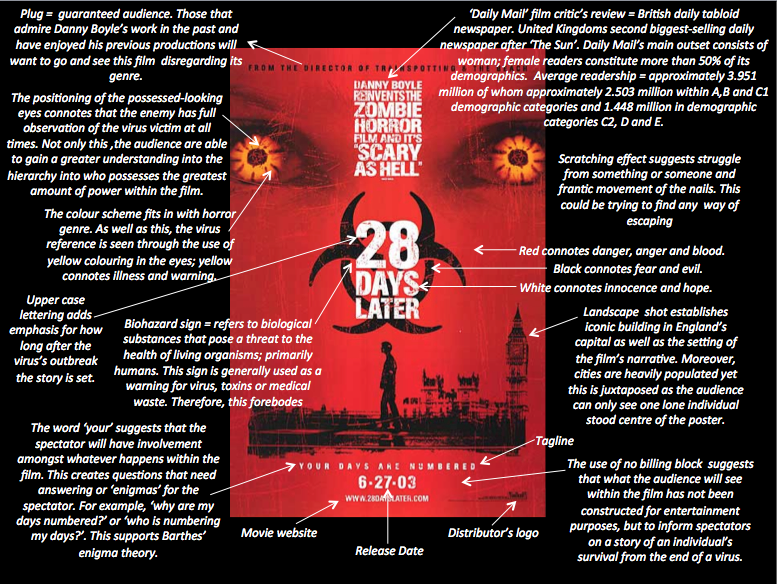
'28 Days Later'
Much like mathematical fractions (dominator and numerator), the number of days remaining dominates how long individuals have had to deal with the virus' damage. Upper case lettering gives the appeal of authority and the scratch effect connotes desperation. The colour red symbolises anger and strength and black symbolises fear and death therefore, the font is able to foreshadow the films narrative.
Whilst watching 'The Magic of Editing', I collated notes that would help build towards my understanding of what the main objective of editing within film is, how editing was established and what my group and I should consider when editing our virus sub-genre teaser trailer.
Originally, individuals would photograph or film whatever interested or amused them. They would hold a shot of something or someone until there was nothing more to film or the film ran out.
Lumier - 'cinema was an invention without a future'
Edwin Porter (One of Thomas Edison's employees) - Established the idea of cutting separate shots to create a story or sequence of events. This process allowed the spectator to be transported to different environments, bridge vast time scales, slow or quicken the speed of action and create relationships with the individuals onscreen. His first production was 'Life of an American fireman' (1903).
Timing is the key to startling audiences or amusing them.
D.W. Griffith understood the psychological importance of editing. His first production was silent film 'Unseen Enemy' (1912) which was released one decade after Porter's discovery of editing clips together. Griffiths production popularise melodramas by allowing the audience to have an insight into the emotional world of the characters.
Griffith's main objective was to make the audience emotionally invested in the story.
The original way of editing film consisted of holding film up to a source of light then checking where the film has been cut by running it through a project to then make the necessary adjustments.
An Editor is the key collaborator to the Director. No other crew member spends as much time with the Director. No other crew member spends as much time with the director then the editor.
The Russian revolution was one of the main catalyst of film editing due to film being the perfect medium to persuade the nation to join the revolution.
Dziga Vertor - a documentary film maker who took his camera into the streets of Moscow, Russia to present to an audience a 'typical day'. His first production was 'Man with a Movie Camera' (1920). This production celebrated revolution as well as the role of the cameraman.
Kuleshov effect allowed the audience to create a third meaning and established the power of montage and juxtaposition; the meaning wasn't in each individual shot, it was amongst the combination of shots. Many orthodox techniques have had an effect on productions that are exhibited nowadays.
To accentuate suspense and action within a scene, the rhythm of shots must be considered. Our ancestors were survivors therefore we can relate to the feeling of being pursued and escaping from danger whether this being someone or something.
F.W. Murnau 'Nosferatu' (1922) played upon the idea of fearing the unknown.
'In the house - In a heartbeat' is an instrumental track by composer John Murphy which was released on June 17 2003 as part of Danny Boyle's Virus sub-genre film '28 Days Later' soundtrack. This track was featured over the climatic confrontation of the film and recurs in several scenes in the sequel '28 Weeks Later'. What I like about this particular soundtrack is the use of overlapping string instruments with ambient guitar chords. John Murphy's composition of the song slowly builds from an isolated single guitar chord to the introduction of a different instrument every moment onwards; this heightens the sense of threat faced by the protagonist. Moreover, the repetition of guitar chords is similar to the pace of a ticking clock therefore, as the pace quickens it could be interpreted that time is running out for the chance of survival. This ultimately evokes the same emotions felt by Jim (protagonist) for the audience as well.
‘The Crazies’ - ‘Mad World’
Release Date - 23rd February 2010
Track Length - 3 minutes 21 seconds
Artist - Gary Jules
'Mad World’ made a popular resurgence when it was re-released in a much slower and sombre minimalist tempo by composers Michael Andrews and Gary Jules for the soundtrack to the movie ‘Donnie Darko’ (2001). This version reached number 1 in the UK in December 2003. It was later in 2010 that ‘Mad World’ was used as the soundtrack to Eisner’s virus sub-genre film ‘The Crazies’. ‘Contagion’ Official Soundtrack Release Date - Unknown Track Length - 3 minutes 2 seconds Artist – Cliff Martinez
Cliff Martinez composed the film’s soundtrack which was his first score since director’s Soderburgh previous film ‘Solaris’ (2002). Given that the pacing of the music was one of Soderburgh’s biggest concerns, Martinez needed to maintain a brisk pace throughout the soundtrack, whilst also conveying fear and hope within the music. Martinez commented during the creation of the film’s soundtrack that ‘(I) tried to use the music to conjure up the sense of tragedy and loss’. What I like about this soundtrack is the atmospheric and abrasive synthesiser sound. ' They're calling my flight' uses piano and synth effect which helps to generate tension through what is know as a music loop. A loop is a repeating section of sound material; short sections of sound can be repeated to create ostinato patterns. Ostinato can be defined as a motif or phase that persistently repeats the same pitch. The use of repetition relates to the film events; for example, when health services in the film feel as though they have the virus under control, a new case is reported and the process of eliminating the virus begins all over again.
‘I Am Legend’ Official Soundtrack
Release Date - Unknown
Track Length - 2 minutes 55 seconds
Artist – James Newton Howard
‘I am Legend’ Official Soundtrack was released on 15th January 2008 and composed by James Newton Howard.